01
SME Marketplace
for Halal SMEs
Trade financing, export finance, and supplier discovery. AI-matched halal businesses with verified global buyers. The wholesale rail.
Malaysia has 20 million Muslims sitting across four chronically under-served banking segments — halal SMEs, gig workers, digital-first millennials, and the rural underbanked. Every Islamic bank fights for one of those segments. None of the math compounds. RM 2 billion left on the table per bank, per year.
That's exactly why Aliph exists. One platform across four life stages, four user-facing products, sixty connections at product level. A complete proposition built for an Islamic-bank subsidiary — market sizing, channel economics, implementation, financial trajectory. The deck never made the room it was built for. This is the work, anonymised.
20 million Malaysian Muslims sit across halal SMEs, gig workers, digital-first millennials, and the rural underbanked. Each segment alone underperforms — branch CAC eats the margin, single-product economics never compound. Every bank picks one. None of them serves all four.
A gig rider becomes a digital saver. The digital saver brings her parents' halal SME onto the platform. The kampung household graduates to digital banking inside two years. One customer base flowing through four life stages, sharing rails, trust signal, and KYC.
Four user-facing products (SME Marketplace · Retail App · Certification Hub · Finance APIs) sit on one shared infrastructure. Sixteen products, fourteen acquisition channels, sixty connections — each segment reached the way it actually wants to be reached. Same RM 18M budget, 76% lower blended CAC, RM 3.2B revenue by Year 3.
Scroll for the full proposition, or jump straight to the sections that earned the click.
One platform, four user-facing products. Each one serves a different part of the halal ecosystem — together they share rails, data, and trust signal.
Trade financing, export finance, and supplier discovery. AI-matched halal businesses with verified global buyers. The wholesale rail.
Shariah-compliant BNPL, auto-Zakat, Umrah savings, real-time wallets. Lifestyle banking built for the segments that won't visit a branch.
Automates halal compliance with direct JAKIM integration. Blockchain verification turns the certification process from months into days.
Complete Islamic finance services any platform can embed — Grab driver onboarding, marketplace seller financing, partner-app Zakat. The wholesale-of-the-wholesale.
A platform built here inherits four advantages before it ships a line of code: the certification rank, the regional gateway, an already-formed SME supply side, and a mature Islamic-finance capital stack. The market opportunity is not the question. The distribution model is.
HFI score 209.8 — 67% above Singapore (125.2), nearly 3× Indonesia (71.5). Trade regulation, public awareness, pricing competitiveness — all measured top of the league.
Asia-Pacific is home to 62% of the world's Muslims, with halal-diet adoption rising across the region. Malaysia is the gateway for any platform that wants regional reach without losing local credibility.
JAKIM-certified halal businesses — food manufacturers, cosmetics producers, halal hotels — form a ready-made acquisition funnel. The platform doesn't need to create the supply side. It needs to bank it.
Malaysia's Islamic banking assets and Sukuk market are deep and globally connected. The regulatory framework for Shariah compliance is decades old. A new platform inherits the rails; it does not have to invent them.
The halal market data confirms the four segments aren't speculative — they're already there, already paying, already waiting. The unsolved problem is reaching them. Which is where every Islamic bank has historically failed.
Pick gig workers — you starve SMEs. Pick SMEs — you skip seven million millennials. Each segment alone underperforms: branch CAC eats the margin, single-product economics never compound, the other three customers belong to someone else.
Result: roughly RM 2B left on the table, every bank, every year. The trap isn't strategic — it's the consequence of a distribution model designed for a different century.



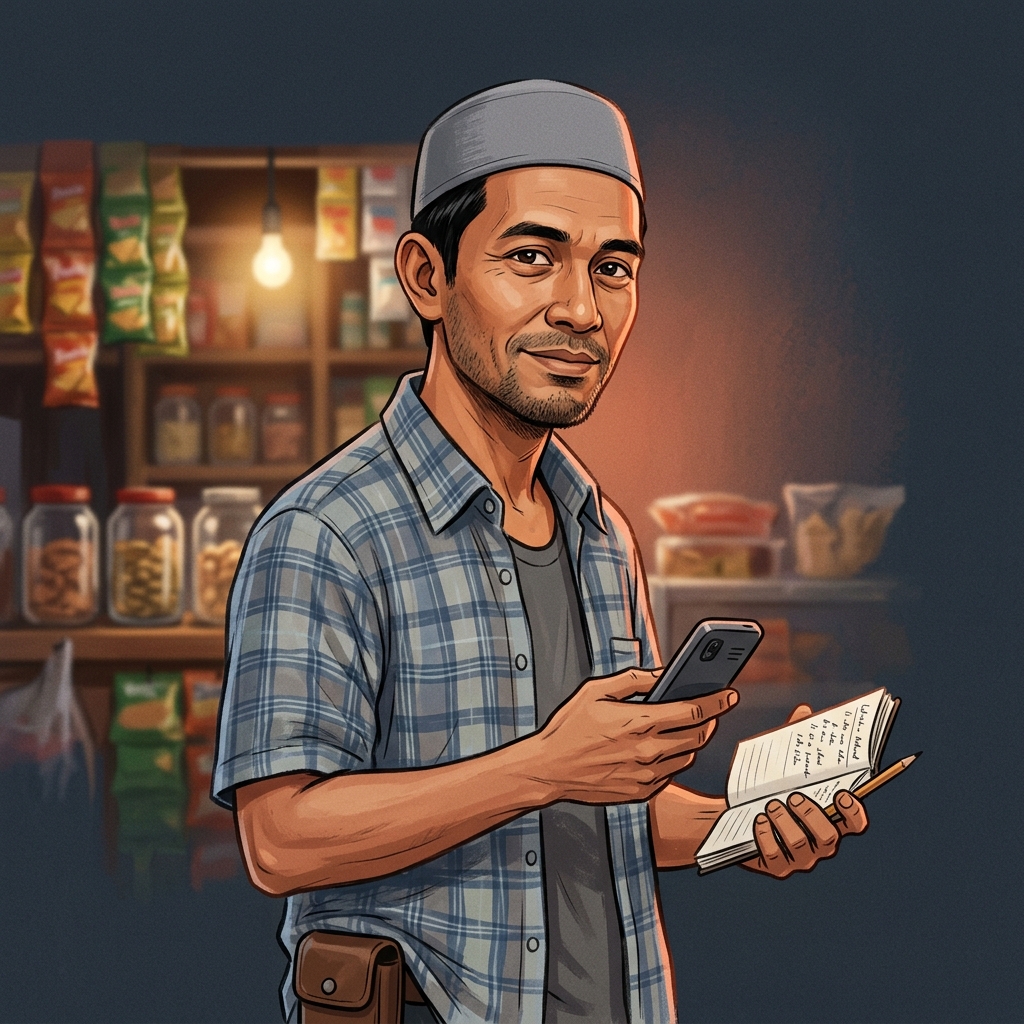
A gig rider becomes a digital saver. The digital saver brings her SME parents on. The kampung household graduates to digital banking inside two years. Stop treating them as four pools. Treat them as one customer base flowing through four life stages.
Share the rails. Share the trust signal. Share the KYC. Your CAC drops 60–80% and acquisition velocity quadruples — not from a better ad campaign, from a better structural choice about what the bank is.
Each segment has distinct cash flows, distinct trust signals, distinct entry points. Tap a tile to see how the platform reaches each one.
Tech-native Muslim millennials and younger Gen X professionals demanding seamless digital experiences and feel-good Shariah-compliant financial tools.
20M Muslims × ~35% millennials. Urban, higher disposable income, mobile-native, comfortable with app downloads and social-led discovery. Actively seek Shariah-compliant savings goals, Zakat tooling, halal BNPL.
| Segment | Reachable | Annual TAM | Primary distribution |
|---|---|---|---|
Halal SMEs HSME | 7,000+ | RM 2.5B / yr | B2B marketplace co-listing |
Gig-economy workers RISE | 2.2M | RM 9.2B / yr | Embedded inside gig-platform APIs |
Digital-first Muslims DARE | 7M | RM 33.2B / yr | Social + PWA + referral loyalty |
Underbanked Muslims UB | 8M+ | RM 12.6B / yr | Masjid kiosks + agent network |
Move the sliders. The platform doesn't need more budget — it needs the budget redirected from branch incentives into eight digital channels.
Even spend across all eight channels. Lowest single-channel risk; moderate CAC. Recommended default before you have channel-level conversion data.
| Channel | Spend | Share | Customers | CAC | LTV | ROI |
|---|---|---|---|---|---|---|
API integrations (gig platforms) targets RISE | RM 3.6M | 20% | 38,741 | RM 93 | RM 3,200 | 3344% |
Social media advertising targets DARE | RM 2.7M | 15% | 32,720 | RM 83 | RM 4,500 | 5353% |
Search & display targets DARE / HSME | RM 2.7M | 15% | 26,493 | RM 102 | RM 4,200 | 4021% |
Community agents (mosque, NGO) targets Underbanked | RM 1.8M | 10% | 15,303 | RM 118 | RM 5,000 | 4151% |
Email & content marketing targets DARE | RM 1.8M | 10% | 27,870 | RM 65 | RM 4,000 | 6093% |
Retail kiosks targets Underbanked / HSME | RM 1.8M | 10% | 18,752 | RM 96 | RM 3,500 | 3546% |
B2B marketplace partnerships targets HSME | RM 1.8M | 10% | 21,100 | RM 85 | RM 3,800 | 4354% |
Referral & loyalty targets DARE / RISE | RM 1.8M | 10% | 38,187 | RM 47 | RM 3,000 | 6265% |
How acquisition scales (and saturates) as you push more budget through the current mix. The flat tail is what every bank discovers eventually: more spend, fewer marginal customers.
Three of the eight channels (referral, embedded API, social) sit at CAC ≤ RM 60. As mix tilts toward them, blended CAC compresses fast. The remaining channels exist to reach segments those three can't.
The platform doesn't earn from the wallet float. It earns from the second product. The same customer base used four ways — savings, BNPL, financing, advisory — is where the LTV multiple lives.
Current mix produces ~219K customers against your 65K target. The platform is over-funded for this acquisition goal — surplus can fund Year-2 LTV plays.
Replace branch dependency with eight digital channels, each optimised for the segment it reaches. All funnel into a single onboarding and cross-sell engine.
Inside Grab and Foodpanda driver apps, micro-loan widget with instant onboarding. The bank reaches the customer where they already are.
Instagram and TikTok campaigns with halal-lifestyle positioning. Influencer partnerships compound the paid spend.
Embedded financing offers on the B2B halal marketplaces where SMEs already source and sell. Trust borrowed from the marketplace.
Mosque kiosks and NGO partnerships for rural outreach. The trust signal arrives before the product offer does.
Built from the ground up for Muslim customers — not a conventional product with a Shariah label bolted on. Every flow, every default, every default product is the halal one.
Tailored products for gig workers, millennials, SMEs, and the underbanked — no one-size-fits-all. Each segment receives a product designed against its actual cash-flow and trust signals.
Mosque, NGO, Zakat board, halal marketplace, gig platform — the platform borrows trust from the communities it serves, instead of trying to build trust from a brand campaign.
A gig rider becomes a digital saver. The digital saver brings her SME parents on. The kampung household graduates inside two years. The platform is worth more than the sum of its segments because of the flow between them.
Quick wins (millennials) fund the blue-ocean push (gig workers), which funds the harder segments (SMEs and underbanked). Sequencing is the strategy.
Revenue grows 3.2× not from more spend, but from fundamentally better unit economics: cheaper acquisition, higher LTV, more products per customer.
RM 54M deployed across 18 months returns RM 2.8B in net new revenue by Year 3 — a 350% three-year ROI on the marketing spend alone, before counting the RM 1.4B deposit base the platform has accumulated to fund the next product line.
Four failure modes the proposition was stress-tested against — regulatory, integration, adoption, competitive. Each one has a named response, not a hope.
Extended approvals for new digital banking features could push the launch deeper into the year, costing first-mover advantage.
API integration with gig platforms (Grab, Foodpanda) may encounter unexpected technical issues — version drift, rate limits, or platform policy changes mid-program.
Traditional bank customers may resist switching to a new digital platform despite incentives, especially older and more affluent segments.
New digital banks and incumbent Islamic banks may launch their own digital channels within 12–18 months.
The ecosystem worked at product level — sixteen products, fourteen channels, three touchpoints, three infrastructure services. Tap a segment on the diagram to isolate it. Tap more than one to see what they share.
The platform is worth more than the sum of its segments because it isthe sum, plus the cross-feed between them. A competitor can copy any one product. They can't copy sixty connections.
Most consulting sites show logos. This one shows the work. If the thinking matches the kind of problem you're carrying — Islamic finance, segment strategy, distribution-model redesign, digital transformation inside a regulated entity — the conversation is short.